
The evolution of Bitcoin transactions has brought forward crucial considerations around privacy, security, and the growing importance of non-KYC acquisition methods. This comprehensive analysis explores the technical and practical implications of various Bitcoin transaction methods, with a particular focus on maintaining financial privacy in an increasingly surveillant world.
The foundation of Bitcoin privacy begins with understanding the distinction between KYC (Know Your Customer) and non-KYC Bitcoin. While KYC Bitcoin purchased through regulated exchanges leaves records, kept for years, that link identities to transactions, non-KYC Bitcoin acquired through peer-to-peer methods offers significantly enhanced privacy. However, this privacy advantage comes with important technical considerations and tradeoffs that must be carefully evaluated.
CoinJoin technologies represent a critical development in Bitcoin privacy enhancement, though their implementation requires careful consideration. These protocols allow multiple parties to combine their transactions in ways that obscure the links between inputs and outputs, while importantly not acting as mixers or tumblers. The distinction is custody: in a CoinJoin nobody hands their coins to anyone else. Its outputs are new coins, but they are usually easy to recognise as CoinJoin outputs, and some exchanges question deposits of coinjoined coins.
Lightning Network transactions add another layer of privacy considerations. The second-layer solution inherently provides better transaction privacy than on-chain operations, as surveillance becomes significantly more difficult. Non-custodial Lightning wallets, when properly implemented, can serve as effective tools for maintaining transaction privacy while enabling rapid, low-cost transfers. However, the choice of wallet and implementation details matter significantly.
The intersection of privacy and custody presents particular challenges as the ecosystem matures. Custodial solutions, while often more convenient, inevitably create privacy vulnerabilities through KYC requirements and centralized data collection. Non-custodial solutions maintain better privacy but require users to manage their own security and key storage. This tradeoff becomes especially relevant when considering lending and yield-generating options.
Looking toward future developments, emerging technologies like Fedimints and privacy-focused Layer 2 solutions may offer new possibilities for maintaining financial privacy while enabling more complex financial operations. However, these must be approached with careful consideration of the technical tradeoffs and potential privacy implications involved.
The economics of privacy must also be carefully considered. Whether paying premium rates for non-KYC Bitcoin or accepting higher fees for CoinJoin transactions, users must evaluate the cost-benefit ratio of various privacy-enhancing methods. This calculation becomes particularly relevant as transaction fees potentially rise with increased network usage.
As the regulatory landscape continues to evolve, the importance of understanding and implementing proper privacy practices becomes increasingly crucial. Users must carefully consider their threat models and privacy requirements while staying informed about the technical capabilities and limitations of various solutions.
The future of Bitcoin privacy will likely involve a combination of technical solutions, from improved CoinJoin implementations to more sophisticated Lightning Network privacy features. Success will require careful balance between usability, security, and privacy while maintaining the fundamental principles of Bitcoin’s decentralized nature.
Step-by-Step Guide
This guide walks through specific techniques for enhancing the privacy of your Bitcoin transactions at each stage, from sending to receiving.
- Set up a privacy-focused wallet with coin control
Install Sparrow Wallet on a desktop computer. During initial setup, connect the wallet to your own Bitcoin full node over Tor. If you do not run a full node, configure the wallet to use its built-in Tor connectivity to reach public Electrum servers. Coin control is built into Sparrow, with nothing to switch on: on the UTXOs tab, select the coins you want to spend and click Send Selected. Choosing them yourself stops the wallet from automatically combining UTXOs from different privacy contexts, which would link them on-chain. (zkSNACKs switched off Wasabi Wallet’s original coinjoin coordinator on 1 June 2024; Wasabi still coinjoins, but you now choose an independent coordinator yourself, as Step 3 explains. Sparrow remains a robust wallet for coin control, labeling, signing, and node connectivity.)
- Label every UTXO at the moment of receipt
When you receive Bitcoin, immediately label the UTXO with its source: the exchange name, the peer-to-peer platform, the CoinJoin round number, or the person who sent it. Include whether the source involves KYC. Sparrow Wallet stores these labels locally and shows them on the UTXOs tab, so you can see each coin’s source when you pick what to spend; its automatic coin selection ignores them. Without labeling, you risk accidentally spending a non-KYC UTXO alongside a KYC-linked one months later when you have forgotten the origin. Labeling is a low-effort habit that prevents high-impact privacy failures.
- Run CoinJoin on exchange-withdrawn Bitcoin before storage
Update (April 2024): Samourai Wallet and its Whirlpool coordinator were seized by the DOJ/FBI, and the founders were arrested and charged with money-laundering conspiracy and running an unlicensed money-transmitting business. The original Whirlpool coordinator no longer operates, and Sparrow Wallet removed its Whirlpool integration in v1.9.0. The instructions that once pointed at “the Whirlpool integration in Sparrow” no longer apply; do not go looking for a Whirlpool coordinator inside Sparrow, and treat any site offering the “original” Samourai coordinator as a red flag for a scam or a trap.
The goal of this step still holds: after withdrawing Bitcoin from a KYC exchange, break the deterministic link between the withdrawal address and your stored coins by running the UTXOs through a CoinJoin protocol. Options that still work in November 2026 (our CoinJoin lesson compares them in a dated table):
- JoinMarket NG — a decentralized CoinJoin with no central coordinator. You act as a taker (you pay a small fee and initiate a coinjoin) or a maker (you offer liquidity and earn fees; the taker learns which outputs are yours, so makers get weaker privacy). To unlink your own withdrawal, you are the taker. There are no fixed pool denominations; you specify an amount and, if you want, the number of counterparties, and the protocol assembles the transaction from available makers. JoinMarket NG is an independent reimplementation of the JoinMarket protocol that joins the same market; it is new code, used mainly from the command line, and Jam 2.0, a web interface that runs on it, is in beta. Do not use the original JoinMarket software: it was archived in April 2026, its page now says “DO NOT USE THIS CODE”, and in every release that includes PayJoin (v0.7.0 to v0.9.12), sending a PayJoin can lose the full value of the coins you spend.
- Wasabi or Ginger Wallet — Wasabi coinjoins in rounds organised by a coordinator you choose in its settings, and since version 2.2 it joins only rounds that charge no coordinator fee. Ginger Wallet is a Wasabi fork that comes set up with its own coordinator, which charges 0.3% on coins above 0.03 BTC. A coordinator can’t take your coins, but it can stop rounds and may learn which outputs are yours.
- Ashigaru Whirlpool — in 2025 a community fork, Ashigaru, relaunched a Whirlpool-style service on a brand-new, Tor-only coordinator independent of the seized Samourai infrastructure (pools of 0.025 and 0.25 BTC, an entry fee of 5% of the pool size, free remixes). Honest trade-off: it is still a centralized coordinator — the same structural single-point-of-failure risk that ended Samourai — and its fee is high, so weigh that before relying on it.
Whichever you choose, allow the UTXO to complete at least one full CoinJoin cycle. The resulting post-mix UTXO has no deterministic link to the exchange withdrawal address.
- Use PayJoin for direct payments when possible
PayJoin (also called P2EP or Pay-to-Endpoint) is a transaction format where both the sender and receiver contribute inputs. This breaks the common-input-ownership heuristic that chain analysis relies on, because an outside observer cannot determine which inputs belong to the sender and which to the receiver. BTCPay Server supports PayJoin natively. When paying a merchant whose BTCPay Server offers PayJoin, your wallet can automatically negotiate a PayJoin transaction, and to everyone else the payment looks like an ordinary one. Your wallet has to support sending PayJoin (Sparrow does); never send one with the original JoinMarket software (see Step 3). PayJoin is a lighter step than a CoinJoin: it doesn’t cut your coin’s trail, because the merchant still sees the coin you spent and your change.
- Implement proper change output management
When you spend only part of a UTXO, the wallet creates a change output sent back to you. This change output is linked to the spent UTXO and can reveal your spending patterns. Configure your wallet to send change to a dedicated change derivation path. For maximum privacy, consider spending the exact UTXO amount when possible (no change) or immediately routing the change through a CoinJoin. In Sparrow Wallet, you can also mark change outputs with a “change” label so you never accidentally treat them as fresh funds.
- Use the Lightning Network for everyday spending
Fund your Lightning wallet from a single post-CoinJoin coin, so the on-chain transaction that opens its channel doesn’t lead straight back to an exchange withdrawal; the amount and timing can still give clues. Use a non-custodial Lightning wallet such as Phoenix; we used to suggest Breez too, but as of November 2026 the original Breez app has left the app stores. Lightning payments are not recorded on the blockchain, and onion routing keeps the nodes in the middle of a route from learning who paid whom. Your wallet’s provider is the exception: Phoenix’s FAQ says that ACINQ, its maker, knows “the final destination and amount of payments”. For recurring payments like subscriptions, Lightning eliminates the on-chain trail that would otherwise accumulate with repeated transactions to the same recipient.
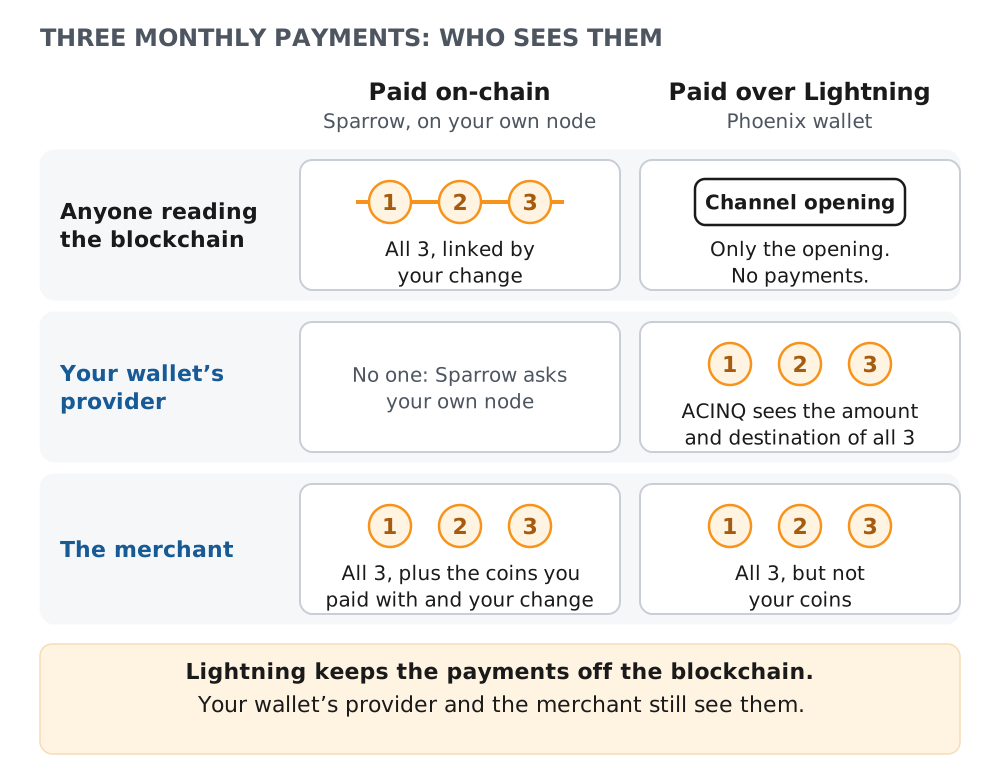
Lightning takes your payments off the blockchain, not out of sight. Phoenix’s FAQ says ACINQ knows “the final destination and amount of payments”. The channel’s opening, and one day its closing, stay public. - Consolidate small UTXOs only when fees are low
Consolidating means sending several small coins to yourself as one, so later payments cost less. Do it when fees are near the floor: check a fee chart such as mempool.space and wait for a quiet period if you are in no hurry. Combine only coins from the same source, such as several withdrawals from one exchange. A KYC or no-ID label isn’t one source: two exchanges, or two sellers who sold you coins without ID, each know only the coin they sent you, and merging tells each of them about the other. Never merge coins from different sources, and don’t merge mixed coins at all, not even with each other, because spending coins together tells everyone they have one owner. A CoinJoin afterwards hides where the merged coin goes next, but it can’t undo the merge: anyone can still see that those coins were spent together.
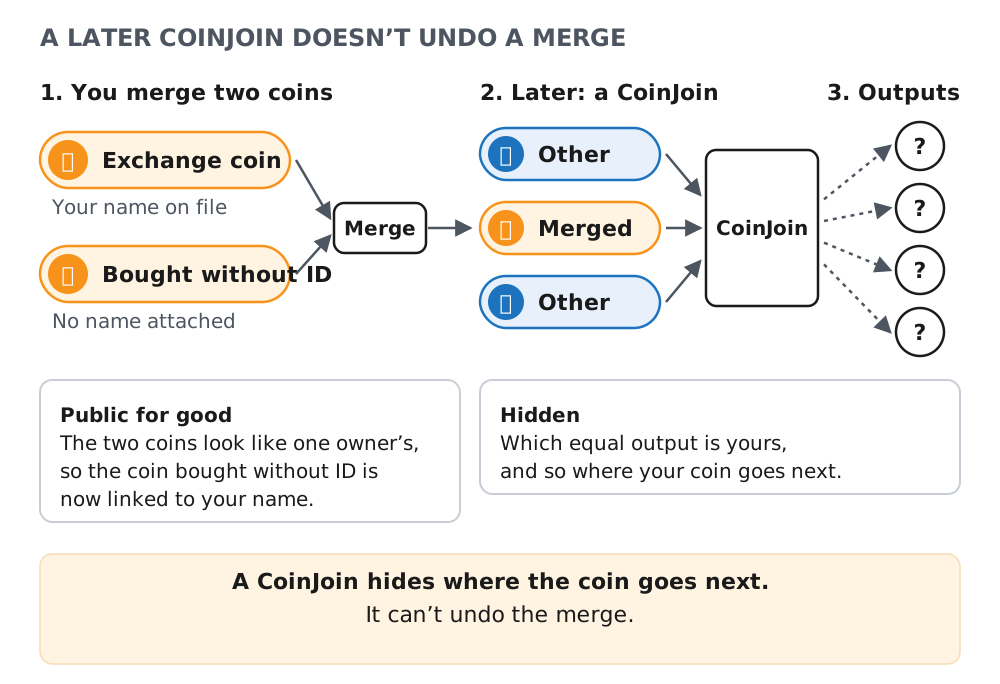
A later CoinJoin can’t undo an earlier merge. Anyone can still see that the two coins were spent together. Merge only coins from the same source.


Common Mistakes to Avoid
Sending CoinJoin outputs directly to a KYC exchange
After completing a CoinJoin, some users deposit the resulting UTXO straight into a KYC exchange. This re-links the CoinJoin output to their verified identity, nullifying the privacy gain. The exchange now knows you performed a CoinJoin, which may flag your account. If you need to sell bitcoin, sell coins from your KYC wallet, which the exchange already links to you, or use a peer-to-peer method. Moving mixed coins through extra wallets of your own before the deposit doesn’t reliably hide where they came from.
Ignoring change output linkage
Change outputs are one of the most reliable tools chain analysis uses to trace funds. When your wallet spends a 0.5 BTC UTXO to send 0.1 BTC, the change comes back as 0.4 BTC minus the fee, and that non-round amount next to a round 0.1 BTC payment makes it easy for anyone reading the blockchain to flag it as change. If you later combine this change with other UTXOs, you link all those funds together. Always treat change outputs as privacy-sensitive: label them, avoid merging them with unrelated UTXOs, and consider running them through CoinJoin.
Using the same wallet for receiving and spending
When you receive Bitcoin to the same wallet from which you spend, transaction graphs make it straightforward to cluster your addresses. A recipient can trace backward through your transaction history, and a sender can trace forward. Maintain at minimum two wallets: one for receiving (cold storage or receive-only) and one for spending. Move coins from one to the other through a CoinJoin: a plain transfer between your own wallets leaves them linked on-chain.
Broadcasting transactions from your home IP
When your wallet broadcasts a transaction, the first node to relay it can associate the transaction with your IP address. Several chain surveillance companies operate Bitcoin nodes specifically to capture this mapping. Always broadcast transactions through Tor or through your own full node running behind Tor. Some wallets like Sparrow allow you to broadcast via a Tor-connected node directly from the transaction interface.
Frequently Asked Questions
What is the difference between CoinJoin and a traditional mixer?
A traditional mixer takes custody of your funds, pools them with other users’ funds, and returns different coins after a delay. This requires trusting the mixer operator not to steal funds or log the mapping. CoinJoin is a non-custodial protocol where participants collaboratively construct a single transaction with multiple equal-value outputs. No one takes custody of anyone else’s funds at any point. The coordinator facilitates communication between participants but never controls the private keys. This distinction matters for security: nobody can run off with your coins. Running a coordinator can still bring prosecution: Samourai’s founders pleaded guilty in July 2025 to conspiring to operate an unlicensed money-transmitting business. For you as a user, the likeliest problem is an exchange questioning coins with CoinJoin history.
How does CoinJoin amount selection work now that Whirlpool is gone?
The original Samourai Whirlpool used fixed pool denominations (0.001, 0.01, 0.05, 0.5 BTC), where you entered a pool smaller than your coin and the remainder came back to you as change. That coordinator was seized in April 2024 and no longer operates. Today the mechanics depend on the tool. JoinMarket NG, a decentralized maker/taker CoinJoin, has no fixed denominations at all: you specify the amount and, if you want, the number of counterparties, and the protocol assembles the transaction from available makers, so you are not forced into a pool ladder. (Use JoinMarket NG, not the original JoinMarket software, which was archived in April 2026 and must not be used.) Wasabi’s rounds also let each participant put in and take out different amounts. The Ashigaru fork’s relaunched Whirlpool coordinator still uses fixed pools (0.025 and 0.25 BTC) but is a centralized coordinator with an entry fee of 5% of the pool size. Wasabi gives any small leftover (up to 10,000 sats per coinjoin) to the coordinator and only rarely returns change. In JoinMarket and in fixed pools, whatever doesn’t fit an equal output normally comes back to you as change that stays linked to your coin; with fixed pools it is larger and easy to spot, which is why it is called toxic change. Keep any change apart from your mixed coins. Letting a UTXO remix over multiple rounds increases privacy at the cost of time.
Can Lightning Network payments be traced by chain surveillance firms?
Lightning payments are significantly harder to trace than on-chain transactions because they use onion-routed payment channels. An intermediary routing node only knows the previous and next hop, not the full payment path. The exception is your wallet’s provider: with Phoenix, ACINQ sees the amount of every payment you send and usually the destination too; only paying a BOLT 12 offer from someone not on Phoenix can hide who you paid. Also, the channel opening and closing transactions are visible on-chain. If you open a channel directly from a KYC exchange withdrawal, the channel capacity and timing are linked to your identity. To mitigate this, open channels using post-CoinJoin UTXOs and avoid closing channels at predictable intervals.
What is a PayJoin and why does it break chain analysis?
A PayJoin is a transaction where both the sender and receiver contribute inputs. In a standard Bitcoin transaction, all inputs belong to the sender. Chain analysis relies on this assumption (common-input-ownership heuristic) to cluster addresses. When a PayJoin includes inputs from both parties, this assumption fails. Done well, a PayJoin looks to an outside observer like a regular transaction with multiple inputs (careless input or fee choices can make one stand out), which forces chain analysis to consider that any multi-input transaction might be a PayJoin, degrading the reliability of clustering across the entire network.
Related Resources
- Bitcoin UTXO Privacy Management: Full Guide
- Bitcoin CoinJoin: Mixing Strategies Guide
- Digital Surveillance and Bitcoin Privacy
- Bitcoin Wallet Privacy Features Explained
- Bitcoin Privacy Economics: Cost-Benefit