Why Metal Seed Phrase Backups Matter
Paper is the default medium for recording a seed phrase during wallet setup. It works — until it does not. A house fire reaches 1,100°F in under four minutes. A burst pipe or basement flood turns paper to pulp. Even slow degradation from humidity, sunlight, or simple aging can render handwritten words illegible over a span of years. For a backup that must remain readable for decades, paper is an inadequate material.
Metal seed backups solve this by encoding your recovery words into stainless steel or titanium — materials that withstand temperatures exceeding 2,500°F, resist water damage entirely, and shrug off corrosion. When your seed phrase is the sole backup for your Bitcoin holdings, the physical medium carrying those words needs to be at least as durable as the cryptography protecting them.
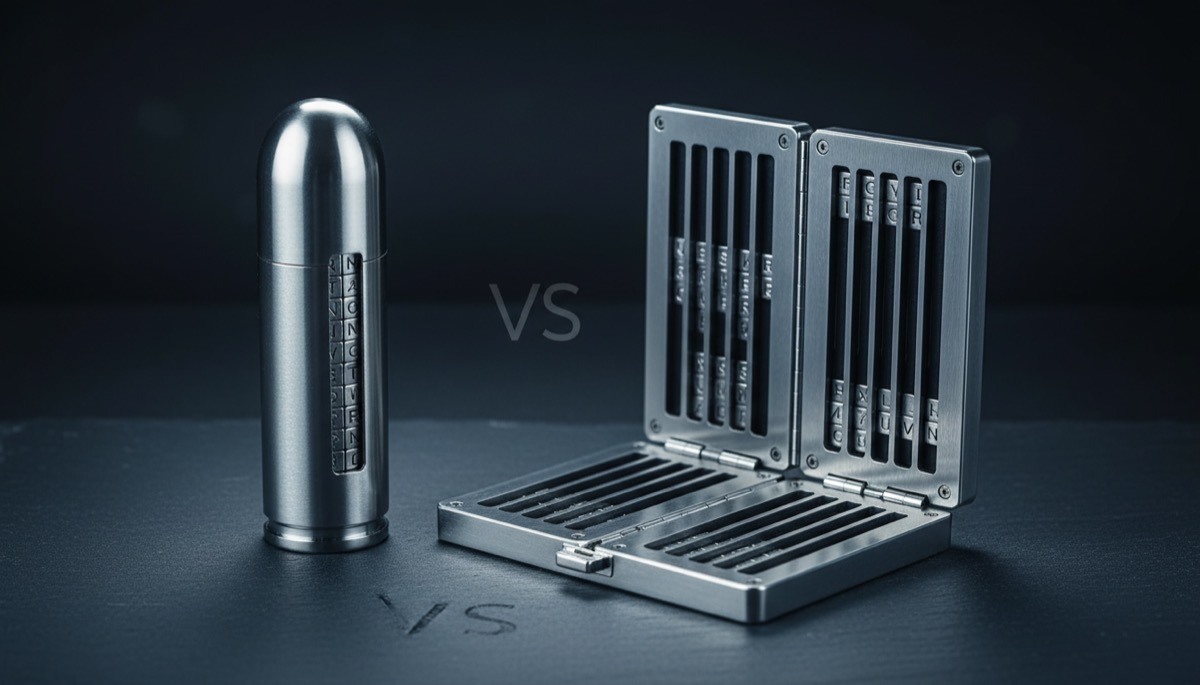
Two products dominate this market: the Cryptosteel Capsule and the Billfodl. Both are well-engineered, widely reviewed, and priced similarly. But they differ in design philosophy, material grade, capacity, and usability — differences that matter depending on your security requirements and storage plans.
Cryptosteel Capsule: Design and Specifications
The Cryptosteel Capsule is a cylindrical stainless steel container that stores seed phrase characters on individual stamped metal tiles threaded onto a steel core. Produced by the Czech company Cryptosteel (formerly known as Cryptosteel.com, now part of the broader Ledger ecosystem after acquisition), it was one of the first dedicated metal backup products on the market.
Material: 304-grade stainless steel (18/8 chromium-nickel alloy). This grade resists corrosion in most environments and has a melting point of approximately 2,550°F (1,400°C). It is the most common stainless steel grade used in industrial applications, food processing, and architectural fixtures.
Design: The capsule is cylindrical, roughly the size of a thick marker. Metal tiles — each stamped with a single letter or number — slide onto a central steel rod. Separator tiles divide words. The rod inserts into the capsule body, which is then sealed with a threaded cap. The sealed capsule is compact and can be stored in a safe, buried, or hidden in tight spaces.
Capacity: Up to 123 characters total. This is enough to store the first four letters of each word in a 24-word BIP39 seed phrase (96 characters for the words, plus separators). Since BIP39 words are uniquely identifiable by their first four characters, storing the full word is unnecessary. The extra capacity allows for additional information like a passphrase hint or wallet label.
Assembly: Setting up a Cryptosteel Capsule is a manual process. You select the correct letter tiles from a sorted tray, slide them onto the core rod one at a time, insert separator tiles between words, and screw the capsule shut. The process takes 20-40 minutes depending on dexterity and familiarity. The tiles are small (about 4mm), and working with them requires patience and good lighting. Tile order on the rod must match word order in the phrase — an error means disassembling and starting over.
Price: Approximately $105 USD at retail. Prices vary slightly by vendor and region.
Billfodl: Design and Specifications
The Billfodl, manufactured by Privacy Pros, takes a different approach. It is a flat, rectangular stainless steel unit with a hinged cover, resembling a small book or case. Characters are arranged in rows visible through a slotted frame, with individual letter tiles slid into position along channels.
Material: 316-grade stainless steel (also known as marine-grade). Grade 316 adds molybdenum to the chromium-nickel alloy, significantly improving resistance to chloride corrosion (saltwater, road salt, chemical exposure). Its melting point is approximately 2,500°F (1,375°C) — slightly lower than 304 but with superior corrosion resistance in harsh environments. For long-term burial or coastal storage, 316 has a measurable advantage.
Design: The flat, rectangular form factor allows the Billfodl to be stored alongside documents in a safe or safety deposit box. The hinged cover protects the tiles when closed. When opened, words are laid out in a grid pattern — each row corresponds to one word of the seed phrase. The physical layout mirrors how you would read the phrase on paper: top to bottom, left to right.
Capacity: Stores the first 4 letters of each word, with space for up to 24 words. This means 96 characters maximum of seed phrase data. Unlike the Cryptosteel, there is no extra capacity for additional notes or passphrases. Each slot is fixed to a word position, which eliminates ambiguity about where one word ends and the next begins.
Assembly: Tiles slide into labeled channels from the side. Each row is clearly numbered (1-24), and the fixed grid makes it straightforward to verify the phrase after assembly. Most users report assembly times of 15-30 minutes. The tiles are slightly larger than Cryptosteel’s and easier to handle, though the channels can be tight and may require a small tool to push tiles into place.
Price: Approximately $105 USD at retail, comparable to the Cryptosteel Capsule.
Side-by-Side Comparison
| Feature | Cryptosteel Capsule | Billfodl |
|---|---|---|
| Material grade | 304 stainless steel | 316 marine-grade stainless steel |
| Form factor | Cylindrical (marker-sized) | Flat rectangular (credit card width) |
| Character capacity | Up to 123 characters | Up to 96 characters (first 4 letters x 24 words) |
| Tile type | Stamped steel, threaded on rod | Laser-engraved, slotted into channels |
| Assembly time | 20-40 minutes | 15-30 minutes |
| Ease of verification | Must unscrew and slide rod out to read | Open hinged cover and read grid directly |
| Melting point | ~2,550°F (1,400°C) | ~2,500°F (1,375°C) |
| Corrosion resistance | Good (standard environments) | Excellent (marine, chemical, buried) |
| Retail price | ~$105 | ~$105 |
| Manufacturer | Cryptosteel (Czech Republic) | Privacy Pros (USA) |
| Extra capacity for passphrase | Yes (27 additional characters) | No |
| Tamper evidence | Threaded cap can be sealed | No built-in tamper evidence |
Durability Testing: What the Stress Tests Show
Jameson Lopp — Bitcoin developer and co-founder of Casa — has conducted widely referenced stress tests on metal seed storage devices. His tests subject devices to extreme heat (via propane torch and house fire simulation), corrosion (acid baths, saltwater immersion), and crushing (hydraulic press). The results are publicly available and worth reviewing before purchasing any metal backup.
Both the Cryptosteel Capsule and Billfodl performed well in fire tests, surviving temperatures consistent with residential house fires with legible data intact. In corrosion testing, the Billfodl’s 316 steel showed somewhat better resistance to chemical attack than the Cryptosteel’s 304 steel, consistent with metallurgical expectations. Neither device suffered catastrophic failure under standard crush tests, though individual tile legibility can be affected under extreme force.
The tests also revealed important failure modes to consider. Some devices from other manufacturers had tiles that shifted or fell out during heat tests, making the stored data ambiguous or unrecoverable. The fixed-channel design of the Billfodl resists this failure mode better than loose-tile designs. The Cryptosteel’s threaded capsule keeps tiles in sequence but they can shift if the rod is not fully seated or the cap is not tight.
These real-world tests underscore why the choice of backup medium is a serious seed phrase storage decision — not all metal backups are created equal, and construction details matter as much as the material grade.
Other Metal Backup Alternatives Worth Considering
While the Cryptosteel and Billfodl dominate the market, several other products deserve mention:
CryptoTag Zeus. Made from solid titanium (melting point ~3,034°F / 1,668°C), the CryptoTag Zeus uses a hammer-and-punch system to physically indent characters into thick titanium plates. The result is extremely durable — there are no tiles to fall out, shift, or separate. The trade-off is that the process is loud, permanent (errors cannot be easily corrected), and requires more physical effort. It is also more expensive, typically around $160-190. For those prioritizing absolute durability over ease of assembly, the Zeus is a strong choice.
Blockplate. A simpler, lower-cost option. Blockplate uses a center-punch system on steel plates — you mark specific grid positions that correspond to your seed words using a basic punch tool. No tiles, no moving parts, nothing to assemble. It is the fastest method to set up and one of the hardest to tamper with, since the punched marks are permanent deformations in the steel. Priced around $60-80.
Seedplate (by Coinkite). A single steel plate with a grid where you stamp dots corresponding to each word. Similar in concept to Blockplate but designed specifically for compatibility with Coldcard wallet workflows. Compact, inexpensive (around $35-50), and effectively indestructible. The downside is that reading the stamped dots back requires the reference chart — the data is not as intuitively readable as letter tiles.
All of these products serve the same fundamental purpose: encoding your seed phrase into a medium that will outlast paper by decades and survive disaster scenarios. For guidance on how metal backups fit into a broader self-custody architecture, our overview of cold storage and risk management covers the complete picture.
Which One Should You Choose?
The right choice depends on your specific circumstances:
Choose the Cryptosteel Capsule if you need a compact form factor for concealed storage, want extra character capacity for a passphrase or additional data, or prefer a device that can be sealed and is less obviously a cryptocurrency backup to a casual observer. The cylindrical shape fits into hiding spots that a flat device cannot.
Choose the Billfodl if you prioritize ease of assembly and verification, plan to store the backup in a marine or chemically harsh environment, or value the ability to quickly open and visually verify your phrase without full disassembly. The flat layout and numbered rows make periodic verification checks faster and less error-prone.
Choose CryptoTag Zeus if maximum physical durability is your top priority and you are willing to pay more for titanium construction and permanent stamping. Best for long-term, set-and-forget storage in extreme environments.
Choose Blockplate or Seedplate if you want a budget-friendly option that eliminates the complexity of tile management entirely. The punch-mark system is faster to set up and has no moving parts that can shift over time.
Regardless of which product you choose, the metal backup is only one component of a complete security strategy. It must be stored in a physically secure location with controlled access. For high-value holdings, consider using metal backups as part of a multisignature setup where the compromise of any single backup does not compromise your funds. And for those thinking about what happens to these backups across decades, our guide on Bitcoin inheritance and long-term asset protection addresses the planning that metal alone cannot solve.
Protecting Your Metal Backup from Physical Threats
A metal seed backup resists fire and water, but it does not resist theft. Anyone who finds your Cryptosteel or Billfodl and can read the tiles has full access to your Bitcoin. Physical security of the backup is as important as its material durability.
Store metal backups inside a quality safe rated for fire and burglary resistance. UL-rated residential safes (TL-15 or higher for burglary, minimum 1-hour fire rating) provide reasonable protection. A bank safety deposit box is another option, though it introduces counterparty risk and access limitations during bank closures or legal proceedings.
For additional protection, consider using a BIP39 passphrase in conjunction with your metal backup. Even if the 24 words engraved on your Cryptosteel or Billfodl are discovered, the attacker still needs the passphrase to access the wallet containing your primary funds. This layered approach — something you have (the metal backup) plus something you know (the passphrase) — significantly raises the bar for physical attackers. The mechanics of this approach are explained in our guide on wallet passphrases and recovery best practices.
Seed Phrase Storage Best Practices from the
Bitcoin Wallets & Self-Custody course.
Frequently Asked Questions
Can a house fire destroy a Cryptosteel Capsule or Billfodl?
Under normal house fire conditions, no. Average residential fires reach peak temperatures of 1,100-1,500°F. Both the Cryptosteel (304 steel, melts at ~2,550°F) and Billfodl (316 steel, melts at ~2,500°F) will survive intact. The stamped or engraved characters remain legible after fire exposure. However, tiles could potentially shift in extreme conditions if the device is not properly sealed. Stress tests by Jameson Lopp and others have confirmed both devices survive simulated house fires with data intact. For context on how these backups fit into your broader security model, see our custody security guide.
Do I need to store all 24 words, or just the first 4 letters of each?
The first 4 letters of each word are sufficient. The BIP39 word list was designed so that every word is uniquely identifiable by its first four characters — no two words share the same four-letter prefix. Both the Cryptosteel and Billfodl are designed around this principle. Storing full words would require significantly more capacity with no security or recoverability benefit.
Is 304 or 316 stainless steel actually better for seed phrase storage?
For most home storage scenarios (inside a safe, in a dry indoor environment), 304 and 316 perform nearly identically. The practical difference emerges in corrosive environments: burial in soil, coastal areas with salt air, or locations with chemical exposure. In those conditions, 316’s molybdenum content provides measurably better corrosion resistance. If you plan to bury your backup or store it in a marine environment, 316 (Billfodl) has an edge. For a standard home safe, either grade will last a lifetime without degradation.
Should I buy multiple metal backups for redundancy?
Creating a second metal backup and storing it at a geographically separate location protects against localized disasters (fire, flood, theft at one location). However, every copy of your seed phrase is a potential attack vector — if anyone finds any copy, they can access your funds. The decision to create redundant backups should weigh disaster risk against theft risk for your specific situation. For high-value holdings, a multisignature wallet setup may be a better approach to redundancy than multiple copies of the same seed. Our analysis of hardware diversity in multisig security covers how to distribute trust without multiplying single points of failure.
For a broader perspective, explore our hardware wallet buying guide guide.
{“@context”: “https://schema.org”, “@type”: “FAQPage”, “mainEntity”: [{“@type”: “Question”, “name”: “Can a house fire destroy a Cryptosteel Capsule or Billfodl?”, “acceptedAnswer”: {“@type”: “Answer”, “text”: “Under normal house fire conditions, no. Average residential fires reach peak temperatures of 1,100-1,500°F. Both the Cryptosteel (304 steel, melts at ~2,550°F) and Billfodl (316 steel, melts at ~2,500°F) will survive intact. The stamped or engraved characters remain legible after fire exposure. However, tiles could potentially shift in extreme conditions if the device is not properly sealed. Stress tests by Jameson Lopp and others have confirmed both devices survive simulated house fires with…”}}, {“@type”: “Question”, “name”: “Do I need to store all 24 words, or just the first 4 letters of each?”, “acceptedAnswer”: {“@type”: “Answer”, “text”: “The first 4 letters of each word are sufficient. The BIP39 word list was designed so that every word is uniquely identifiable by its first four characters — no two words share the same four-letter prefix. Both the Cryptosteel and Billfodl are designed around this principle. Storing full words would require significantly more capacity with no security or recoverability benefit.”}}, {“@type”: “Question”, “name”: “Is 304 or 316 stainless steel actually better for seed phrase storage?”, “acceptedAnswer”: {“@type”: “Answer”, “text”: “For most home storage scenarios (inside a safe, in a dry indoor environment), 304 and 316 perform nearly identically. The practical difference emerges in corrosive environments: burial in soil, coastal areas with salt air, or locations with chemical exposure. In those conditions, 316’s molybdenum content provides measurably better corrosion resistance. If you plan to bury your backup or store it in a marine environment, 316 (Billfodl) has an edge. For a standard home safe, either grade will l…”}}, {“@type”: “Question”, “name”: “Should I buy multiple metal backups for redundancy?”, “acceptedAnswer”: {“@type”: “Answer”, “text”: “Creating a second metal backup and storing it at a geographically separate location protects against localized disasters (fire, flood, theft at one location). However, every copy of your seed phrase is a potential attack vector — if anyone finds any copy, they can access your funds. The decision to create redundant backups should weigh disaster risk against theft risk for your specific situation. For high-value holdings, a multisignature wallet setup may be a better approach to redundancy tha…”}}]}