
The landscape of Bitcoin self-custody continues to evolve as users navigate the delicate balance between security, accessibility, and practical usability. For a deeper look at this topic, see our guide on Bitcoin self-custody security. This exploration delves into the various approaches to securing bitcoin holdings, examining the merits and considerations of different custody solutions while highlighting the importance of thoughtful security architecture.
The foundation of Bitcoin security begins with understanding the critical role of private key management. Whether implementing single-signature wallets with passphrases or more complex multi-signature arrangements, the fundamental challenge remains consistent: protecting access to private keys while maintaining the ability to recover funds if hardware fails or access is compromised. Our comprehensive guide on Bitcoin multisig security covers this further. This balance becomes increasingly crucial as bitcoin holdings grow in value and users seek institutional-grade security solutions for their personal wealth.
The emergence of collaborative custody solutions has introduced an important middle ground between complete self-custody and traditional financial services. You can learn more about this in our resource on collaborative Bitcoin custody. These arrangements, typically implementing multi-signature protocols, distribute key management responsibilities between the user and a service provider. This approach offers several advantages, particularly for users seeking a balance between security and operational simplicity. The user maintains ultimate control by holding the majority of keys while benefiting from the service provider’s technical infrastructure and backup support.
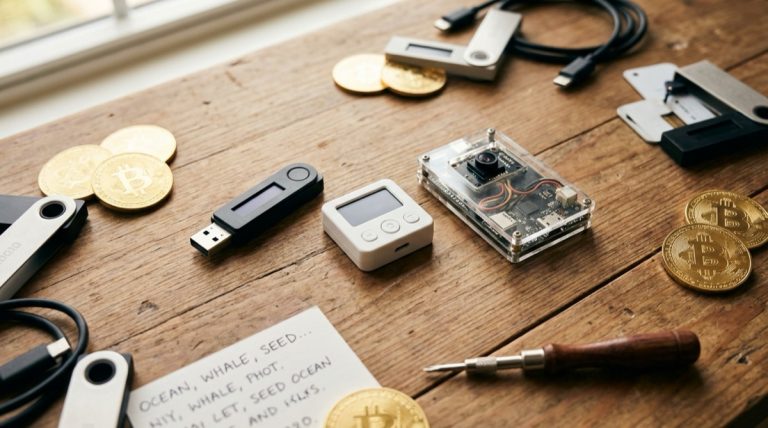
Hardware wallet redundancy has become a central consideration in building robust security systems. The practice of maintaining multiple devices with identical seeds, distributed across different geographic locations, provides an important layer of protection against hardware failure or loss of access. However, this approach introduces its own complexity in terms of managing multiple devices and ensuring consistent security practices across all storage locations.
The role of passphrases in enhancing security deserves particular attention. When implemented correctly, passphrases add a crucial layer of protection beyond the seed phrase itself. This approach effectively creates separate wallets derived from the same seed, allowing users to maintain different balances for different purposes – from cold storage to regular spending. The challenge lies in securely storing these passphrases while ensuring they remain accessible when needed.
Physical backup solutions, particularly steel plates for seed storage, have become a standard practice in the industry. These provide protection against fire, water damage, and other environmental hazards that could compromise paper backups. The distribution of these backups across multiple locations adds another layer of geographic redundancy, though careful consideration must be given to the security of each storage location.
The implementation of multi-signature wallets represents perhaps the most sophisticated approach to Bitcoin security currently available to individual users. These arrangements require multiple keys to authorize transactions, significantly raising the barrier for potential attackers. When combined with collaborative custody services, multi-signature setups can provide institutional-grade security while maintaining practical usability for regular transactions. We explore this in detail in our article on multi-signature wallet configuration.
The question of backup storage locations remains a persistent challenge in Bitcoin security architecture. While bank safety deposit boxes offer one solution, they come with their own risks related to bank stability and regulatory compliance. Private vaults, distributed geographic locations, and trusted family members all present alternative options, each with their own risk-reward profiles.
The integration of encrypted digital backups adds another dimension to comprehensive security solutions. Modern encryption tools allow users to create secure digital copies of critical information, which can be distributed through various channels while maintaining security. This approach provides an additional layer of redundancy beyond physical backups, though it requires careful attention to encryption practices and key management.
Looking toward the future, the evolution of Bitcoin custody solutions will likely continue to emphasize simplicity without compromising security. This topic is explored further in our post on modern Bitcoin custody solutions. The industry trends suggest a movement toward solutions that reduce the number of elements users need to manage while maintaining or improving security standards. This might include innovations in hardware wallet technology, improvements in collaborative custody services, and new approaches to backup management.
In conclusion, successful Bitcoin security architecture requires careful consideration of multiple factors, from hardware redundancy to geographic distribution of backups. The optimal solution often combines multiple approaches – such as multi-signature arrangements for long-term storage with simpler setups for regular transactions. As the ecosystem matures, users must remain vigilant in adapting their security practices while maintaining the delicate balance between protection and accessibility.
Step-by-Step Guide to Implementing a Multi-Sig Custody Setup
- Define Your Security Tiers and Allocate Holdings
Before purchasing any hardware, decide how you will segment your Bitcoin holdings. A common three-tier approach works well: a hot wallet (mobile or desktop) for weekly spending containing no more than one to two percent of total holdings, a single-signature hardware wallet for medium-term savings (ten to twenty percent), and a 2-of-3 multisig cold storage vault for the remaining long-term holdings. Write down the approximate allocation percentages and the maximum dollar value each tier will hold. This prevents over-engineering security for small amounts and under-protecting large ones.
- Select and Procure Hardware Wallets
For the multisig vault, acquire three hardware wallets from different manufacturers — for example, one Coldcard Mk4, one Trezor Safe 3, and one Foundation Passport. Order directly from each manufacturer to avoid supply chain tampering. While waiting for delivery, download and verify the PGP signature of your chosen coordinator software (Sparrow Wallet is well-suited for this workflow). Install it on a dedicated computer or a clean operating system partition that you will use exclusively for Bitcoin operations.
- Initialize Each Device in an Air-Gapped Environment
Power on each hardware wallet in a room with no network-connected devices nearby. Generate a new 24-word seed phrase on each device using its built-in random number generator. Stamp each seed phrase into a separate metal backup plate using a letter punch set and hammer — do not write on paper. Label each metal plate with the device manufacturer name and a cosigner number (e.g., “Cosigner 1: Coldcard”) without including the seed words on the label. Verify each seed by performing the device’s built-in seed verification check.
- Build the Multisig Wallet in Your Coordinator
In Sparrow Wallet, create a new wallet and select “Multi Signature” with a 2-of-3 threshold. Import each hardware wallet’s xpub by connecting the device (or scanning its xpub QR code for air-gapped devices like Coldcard). After importing all three cosigners, Sparrow will display the first several receive addresses. Verify the first address on each hardware device’s screen to confirm the multisig wallet was assembled correctly. If any device shows a different address, the import was incorrect — delete the wallet and restart.
- Export the Wallet Descriptor and Create Redundant Copies
Export the wallet’s output descriptor from Sparrow (File > Export Wallet). This descriptor contains the complete specification needed to reconstruct the wallet: all three xpubs, derivation paths, script type, and quorum. Encrypt this file with GPG using a unique passphrase that you store in a password manager. Copy the encrypted descriptor to two separate USB drives. Label each USB drive clearly (e.g., “BTC Multisig Descriptor – Encrypted”). Store these USB drives at different locations from your seed phrase backups.
- Distribute Backups Across Geographic Locations
Assign each of the three seed phrase metal backups to a separate physical location: your home safe, a bank safety deposit box, and a trusted family member’s secure storage. Place one encrypted descriptor USB at your home and another at the bank. Create a backup map document (no secrets, only locations and labels) and store it in your password manager and as a physical copy with your estate documents. Each location should hold at most one seed phrase and one descriptor copy, ensuring no single-location breach yields both signing authority and wallet reconstruction capability.
- Execute a Full Deposit, Spend, and Recovery Test
Deposit a small amount (50,000 to 100,000 sats) to the multisig vault. Wait for confirmation, then create a spending transaction. Sign with two of three devices, broadcast, and confirm settlement. Next, simulate disaster recovery: on a separate clean computer, install Sparrow, import the encrypted descriptor, connect two hardware wallets, and verify you can reconstruct the wallet and sign a transaction. Finally, test single-device recovery by wiping one hardware wallet, restoring its seed from the metal backup, and confirming it can participate in signing again.
Common Mistakes to Avoid
Storing Seed Phrases Digitally Without Encryption
Taking a photo of your seed phrase, saving it in a notes app, or storing it in an unencrypted text file creates a copy that can be stolen through phone theft, cloud account compromise, or malware. Seed phrases should exist only as physical backups (metal plates in secure locations) or, if a digital copy is absolutely necessary, encrypted with strong cryptography (GPG with AES-256) and a passphrase stored separately. Any unencrypted digital copy of a seed phrase should be treated as a compromised key.
Relying on a Single Geographic Location for All Backups
Keeping your hardware wallets, seed phrase backups, and wallet descriptor all in your home — even in a safe — means a house fire, flood, or burglary can destroy everything simultaneously. The entire value proposition of multisig is redundancy through distribution. If all your redundant components occupy the same physical space, you have single-sig security with multisig complexity. Distribute across at least three locations separated by enough distance that no single natural disaster can affect all of them.
Not Informing Anyone About Your Setup
If you are the only person who knows your multisig configuration exists and where the backups are stored, your Bitcoin becomes permanently inaccessible if you become incapacitated or die. This defeats the purpose of building a robust custody architecture. At minimum, leave a sealed letter with your estate documents that explains the existence of your Bitcoin holdings, references your backup map, and provides enough information for a technically competent heir to begin the recovery process. You do not need to include seed phrases in this letter — just the roadmap to finding them.
Mixing Testnet and Mainnet Operations on the Same Devices
Some users practice with testnet Bitcoin before setting up their real multisig, which is a good instinct. However, using the same seed phrases and devices for both testnet practice and mainnet holdings can create confusion about which wallet is real and which is for testing. Initialize your mainnet multisig with fresh seeds that have never been used on testnet. Keep your testnet practice environment completely separate from your production custody setup.
Frequently Asked Questions
How much Bitcoin justifies the effort of a multisig setup?
There is no fixed threshold, as the answer depends on your personal risk tolerance and the value of your time. As a general benchmark, many security-focused Bitcoin holders implement multisig when their holdings exceed the cost of the hardware (roughly $300-$500 for three devices) by a factor of 20 to 50 — meaning holdings of $10,000 or more. Below that amount, a single hardware wallet with a BIP39 passphrase and a metal seed backup provides adequate security with less operational overhead.
Can I add a new cosigner to my existing multisig without creating a new wallet?
No. A multisig wallet’s quorum structure (the number of cosigners and the signing threshold) is fixed at creation and encoded into the Bitcoin script. Changing from 2-of-3 to 2-of-4, for example, requires creating an entirely new wallet with the desired configuration and transferring all funds from the old wallet to the new one. Plan your quorum structure carefully at the outset, and if your security needs change over time, budget for the on-chain transaction fees of migrating to a new wallet.
What role does a collaborative custody provider play in my multisig setup?
A collaborative custody provider (such as Unchained or Nunchuk) typically holds one key in your 2-of-3 multisig while you hold the other two. Under normal operation, you sign transactions with your two keys and the provider’s key sits idle. If you lose one of your keys, the provider’s key serves as a recovery backup — you can sign with your remaining key plus the provider’s key. The provider cannot move your funds unilaterally because they hold only one of the three keys. The trade-off is that the provider gains visibility into your wallet’s xpubs, meaning they can observe your balance and transaction history.
Do I need to run my own Bitcoin node for multisig?
Running your own node is not technically required for multisig to function, but it provides significant privacy and security benefits. Without your own node, your coordinator software connects to someone else’s server to look up your addresses and broadcast transactions, which reveals your xpubs and IP address to that server operator. With your own node, all wallet queries stay local. For holdings large enough to warrant multisig, the additional effort of running a node (a one-time setup on a Raspberry Pi or old laptop) is well worth the privacy improvement.
Related Resources
- The Evolution of Bitcoin Self-Custody: Balancing Security, Redundancy, and Usability
- Understanding Multisig Wallet Security: Backup Maps, Privacy, and Key Management
- Hardware Wallet Buying Guide 2026
- Self-Custody Bitcoin: Understanding Node Architecture and Wallet Integration
- Bitcoin Multisig: From Beginner to Expert
For enhanced protection, consider Bitcoin Multisig Wallets: Setup and Best Practices.
Quorum-based security improves on this — explore Multisig Security Analysis: Advanced Wallet Tech.
Quorum-based security improves on this — explore MultiSig Backup Maps: Protect Keys and Privacy.
Distributing key custody is covered in Bitcoin Cold Storage and Multisig Security.