Phoenix Wallet has become the benchmark for self-custodial Lightning wallets in 2026. Built by ACINQ — one of the three original Lightning implementation teams — Phoenix is the only mobile wallet that uses splicing to manage a single dynamic channel, eliminating the channel management complexity that has historically made Lightning difficult for regular users. If you want to send and receive bitcoin over the Lightning Network without running your own node or understanding channel mechanics, Phoenix is the wallet that makes it possible.
This review evaluates Phoenix Wallet’s architecture, fee structure, user experience, privacy properties, and real-world performance based on extensive testing in early 2026.
Phoenix Wallet Specifications
| Specification | Detail |
|---|---|
| Developer | ACINQ (Paris, France) |
| Lightning Implementation | Eclair (custom mobile build) |
| Custody Model | Self-custodial (your keys, your coins) |
| Platforms | Android, iOS |
| Channel Management | Automated via splicing (single channel) |
| On-chain Support | Yes (unified balance via swap-in/splice) |
| Invoice Support | BOLT 11, BOLT 12 (Offers), LNURL |
| Backup | 12-word seed + encrypted cloud backup of channel state |
| Privacy | Trampoline routing (ACINQ sees payment destinations) |
| License | Open source (Apache 2.0) |
| Tor Support | Yes |
Architecture: How Phoenix Actually Works
Phoenix runs a lightweight Eclair node directly on your phone. Your private keys and channel state are stored locally on your device — ACINQ never has access to your funds. This makes Phoenix genuinely self-custodial, unlike wallet apps that connect to a third-party custodian behind a friendly interface.
The Splicing Innovation
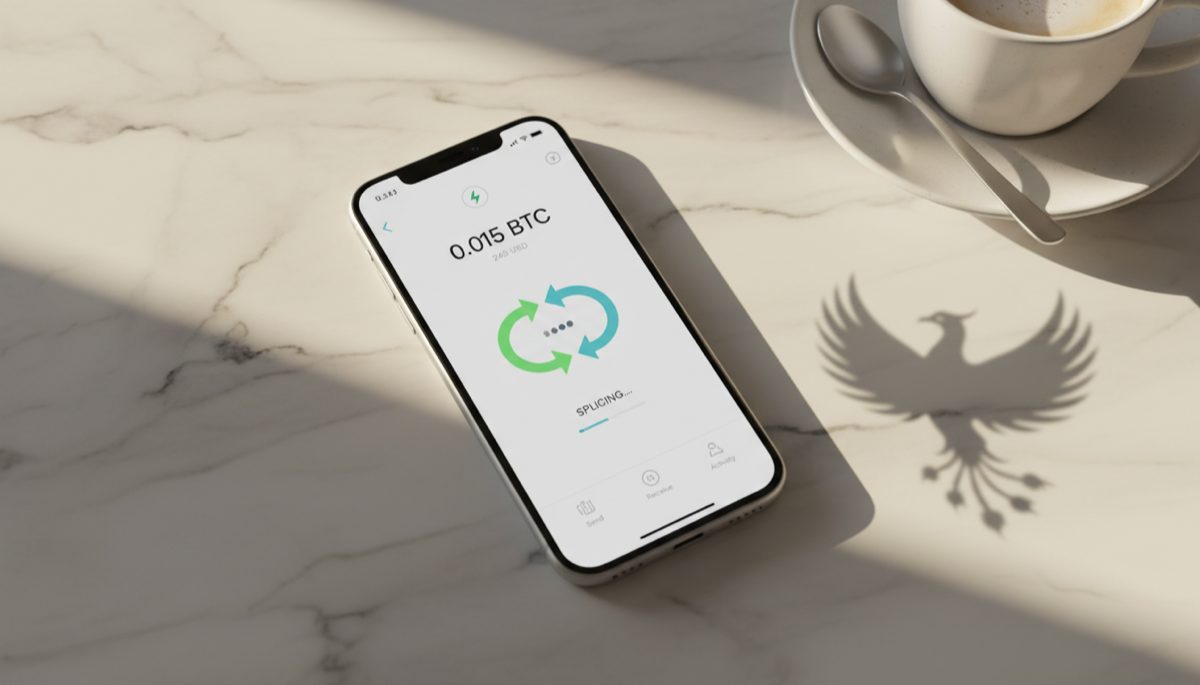
Phoenix’s defining technical achievement is its use of splicing for channel management. In traditional Lightning wallets, you might open and close multiple channels as your needs change — each requiring an on-chain transaction with mining fees. Phoenix maintains a single channel to ACINQ’s node and dynamically resizes it:
- Receiving more than your inbound capacity? Phoenix automatically performs a splice-in, expanding the channel to accommodate the incoming payment. This requires one on-chain transaction.
- Want to move funds on-chain? Phoenix performs a splice-out, directly sending bitcoin from your channel to an on-chain address. No swap service needed — the operation is trustless.
- Channel stays operational during splicing. Unlike traditional channel opens/closes, splicing does not interrupt your ability to send and receive Lightning payments.
The result for users: one balance, no channel management decisions, and a seamless experience that hides Lightning’s underlying complexity without compromising self-custody.
Trampoline Routing
Phoenix does not compute payment routes independently. When you send a payment, Phoenix delegates route-finding to ACINQ’s node using a protocol called trampoline routing. Your phone sends the payment to ACINQ’s node with instructions like “deliver this to destination X,” and ACINQ’s well-connected node figures out the best path.
This design saves bandwidth and battery on your phone, which matters for a mobile wallet. The tradeoff is privacy: ACINQ’s node knows the final destination of every payment you send. For users concerned about this, Phoenix supports Tor connections to obscure your IP address, but the payment destination visibility remains inherent to the trampoline model.
Fee Structure
Phoenix’s fee model changed significantly with the splicing update. Here is the current structure:
- Sending Lightning payments: 0.4% of the payment amount, with a minimum of 4 sats. This fee is fixed and shown before you confirm — no surprises.
- Liquidity fee (splice-in): 1% of the inbound amount with a 3,000 sat minimum, charged when your channel needs to be expanded to receive a payment. This includes the mining fee for the splice transaction.
- Splice-out (on-chain withdrawal): Mining fee for the on-chain transaction only. No additional service fee.
- No monthly fees, no subscription, no base fee.
For context: sending a 50,000 sat (~$50) Lightning payment costs 200 sats (~$0.20) in routing fees. Compare this to on-chain Bitcoin transaction fees during busy periods, which can range from 5,000-30,000 sats. Lightning through Phoenix is dramatically cheaper for everyday payments.
The 1% liquidity fee for channel expansion is higher than managing your own node channels, but dramatically simpler. Most users never want to manually manage inbound and outbound liquidity — Phoenix handles it automatically at a reasonable cost.
User Experience
Setup
Initial setup takes under two minutes: install the app, write down your 12-word seed phrase, and you are ready to receive your first payment. There is no account creation, no email verification, no KYC. Phoenix generates a wallet and Lightning address immediately.
Sending Payments
Tap “Send,” scan a Lightning invoice (BOLT 11), paste an LNURL, or scan a BOLT 12 offer. Phoenix displays the amount and total fee before you confirm. Payment settlement is typically sub-second for well-connected destinations.
Receiving Payments
Tap “Receive,” specify an amount (or leave open for any amount), and Phoenix generates a QR code. If the incoming payment exceeds your current inbound capacity, Phoenix handles the splice-in automatically — you see a notification that a channel management fee will apply before accepting.
On-chain Integration
Phoenix provides a swap-in Bitcoin address for receiving on-chain payments. Funds sent to this address are automatically spliced into your Lightning channel, appearing in your unified balance after the on-chain transaction confirms (typically 1-3 confirmations). This eliminates the mental overhead of managing separate on-chain and Lightning balances.
Backup and Recovery
Phoenix uses a 12-word seed phrase for key derivation, plus an encrypted cloud backup of your channel state stored on ACINQ’s servers. If you lose your phone:
- Install Phoenix on a new device.
- Enter your 12-word seed phrase.
- Phoenix retrieves your encrypted channel state and restores your balance.
This is a significant usability advantage over wallets that require manual Static Channel Backup (SCB) management. The tradeoff: ACINQ stores your encrypted channel state. They cannot access it without your seed phrase, but the data exists on their infrastructure.
Pros and Cons
Pros
- Best user experience of any self-custodial Lightning wallet — genuinely rivals custodial simplicity
- Splicing eliminates channel management complexity entirely
- Unified balance (no separate on-chain and Lightning funds to manage)
- Transparent, predictable fee structure
- Active development by one of Lightning’s core implementation teams
- Open source (Apache 2.0)
- BOLT 12 support enables reusable payment offers
- Tor support for IP privacy
Cons
- Depends entirely on ACINQ’s Lightning Service Provider (LSP) — if ACINQ goes offline, you can still recover funds on-chain but cannot make Lightning payments until they return
- Trampoline routing means ACINQ sees your payment destinations
- 0.4% sending fee is higher than routing through your own node (where you pay only network routing fees)
- No desktop version — mobile only
- Single-LSP dependency means no redundancy for routing
Phoenix vs Other Lightning Wallets
| Feature | Phoenix | Zeus | Breez | Wallet of Satoshi |
|---|---|---|---|---|
| Custody | Self-custodial | Self-custodial | Self-custodial | Custodial |
| Channel management | Automated (splicing) | Manual or LSP | LSP-assisted | None (managed) |
| Technical knowledge needed | None | Moderate to high | Low | None |
| Sending fee | 0.4% | Network only | Network + LSP | None visible (built in) |
| Privacy | Moderate (trampoline) | High (own node) | Moderate (LSP) | Low (full custodial) |
| Best for | Everyday users | Power users | Merchants | Beginners (tradeoff: no custody) |
For a detailed comparison of all these wallets and more, see our comprehensive Lightning wallet comparison.
Verdict: Is Phoenix the Best Lightning Wallet in 2026?
For the majority of users who want self-custody without managing infrastructure, yes. Phoenix is the wallet that proves self-custodial Lightning can be as simple as custodial alternatives — without sacrificing control of your keys. The splicing architecture is genuinely innovative, the fee structure is transparent, and the ACINQ team has a decade-long track record of serious Lightning development.
Phoenix is not the best choice if you prioritize maximum privacy (ACINQ sees your payment destinations), maximum fee savings (running your own node is cheaper), or desktop use (Phoenix is mobile only). For those use cases, Zeus or Alby Hub may be better fits.
But for the person who wants to hold their own keys, make Lightning payments daily, and never think about channels — Phoenix is the answer.
Frequently Asked Questions
Is Phoenix Wallet safe?
Phoenix is self-custodial — you control your private keys via a 12-word seed phrase. ACINQ cannot access or freeze your funds. The main risk is losing your seed phrase, which would make fund recovery impossible. Store your seed phrase securely offline.
How much does Phoenix Wallet cost?
Phoenix is free to download and use. You pay 0.4% per Lightning payment sent, and a 1% liquidity fee (minimum 3,000 sats) when your channel needs to expand for incoming payments. There are no subscriptions, monthly fees, or hidden charges.
Can I receive on-chain Bitcoin with Phoenix?
Yes. Phoenix provides a swap-in Bitcoin address. On-chain funds are automatically spliced into your Lightning channel after confirmation. Your balance appears as a single unified amount — no separate on-chain and Lightning balances to manage.
What happens if ACINQ shuts down?
If ACINQ’s node goes permanently offline, your Lightning channel would need to be force-closed. Your funds would settle on-chain after the timelock expires (typically 2-4 weeks). You would not lose bitcoin — you would lose Lightning functionality until connecting to a different LSP or running your own node. Your seed phrase always allows on-chain recovery.
Does Phoenix support BOLT 12?
Yes. Phoenix supports BOLT 12 offers, which allow reusable payment requests. Instead of generating a new invoice for every payment, you can share a single BOLT 12 offer that others can pay multiple times — useful for donations, recurring payments, or public-facing payment links.
Lightning Wallets Compared from the
Lightning Network & Bitcoin Nodes course.