You don’t need to spend $250 on a cheapest hardware wallet to get real Bitcoin security. Several devices under $100 deliver genuine offline key storage with secure elements, open-source firmware, and proven track records. The catch is knowing which budget options are actually worth your money and which cut too many corners. This guide covers the best affordable hardware wallets available in 2026, ranked by value for Bitcoin holders.
Hardware Wallets Explained from the
Bitcoin Wallets & Self-Custody course.
Budget Hardware Wallet Comparison
| Device | Price | Secure Element | Open Source | Air Gap | Screen |
|---|---|---|---|---|---|
| Blockstream Jade | $65 | Virtual SE | Yes | QR codes | 1.14″ color LCD |
| Trezor Safe 3 | $79 | Optiga Trust M (EAL6+) | Yes | No | 0.96″ OLED |
| Ledger Nano S Plus | $79 | ST33J2M0 (EAL5+) | No | No | 128×64 OLED |
| SeedSigner (DIY) | ~$50-75 | None | Yes | QR codes | 1.3″ LCD (varies) |
1. Blockstream Jade — $65
The Blockstream Jade is the most affordable hardware wallet from a reputable manufacturer that also supports air-gapped operation. At $65, it offers features that many $150+ devices lack.
What You Get
- Air-gapped signing via QR codes — no USB connection needed for transaction signing
- Fully open-source firmware and hardware — everything is auditable
- Built-in camera for QR scanning
- Color LCD screen for address verification
- Bluetooth support for mobile use
- Bitcoin and Liquid Network support
The Tradeoff
Jade uses a “virtual secure element” rather than a dedicated hardware SE chip. The private key is encrypted and stored in the device’s flash memory, with Blockstream’s server (or your own pin server) holding a decryption key. This blind oracle model means that without the correct PIN and server interaction, the encrypted key is useless. It’s a different security architecture than a traditional secure element — some users prefer it for its transparency, others prefer a dedicated chip. For a deeper analysis, see our open-source wallet breakdown.
Best For
Budget-conscious users who want air-gapped QR-code signing at the lowest possible price. Also excellent as a second device in a multisig setup where total cost across multiple devices matters.
2. Trezor Safe 3 — $79
The Trezor Safe 3 packs the same Infineon Optiga Trust M secure element found in the $169 Trezor Safe 5. The core security is identical — what you sacrifice at this price point is the touchscreen experience.
What You Get
- EAL6+ Infineon Optiga secure element — same as the flagship Safe 5
- Fully open-source firmware — auditable on GitHub
- Bitcoin-only firmware option — minimal attack surface
- Trezor Suite compatibility with Tor support and Coinjoin
- USB-C connection
The Tradeoff
The 0.96-inch monochrome OLED screen and single-button navigation make the device less comfortable to use than touchscreen alternatives. Verifying long addresses requires patience. There’s no Bluetooth and no air-gap capability. But if you’re signing transactions infrequently (monthly or less), these limitations are easy to live with.
Best For
Users who want the strongest hardware security (EAL6+ SE + open-source firmware) at the lowest price. The Safe 3 is arguably the best security-per-dollar in the entire hardware wallet market.
3. Ledger Nano S Plus — $79
Ledger’s entry-level device has been around for years and has sold millions of units. It’s the most battle-tested budget option available.
What You Get
- EAL5+ secure element (ST33J2M0) — proven bank-grade chip
- Ledger Live ecosystem — buy, swap, stake, and manage 5,500+ assets
- Up to 100 apps simultaneously
- USB-C connection
- Compact USB-stick form factor
The Tradeoff
Closed-source firmware — you cannot verify what runs on the secure element. The same Ledger Recover capability exists in the firmware. The OLED screen is small and requires scrolling for address verification. No Bluetooth (that’s the Nano X). But if you hold multiple cryptocurrencies and want the broadest ecosystem at $79, the Nano S Plus delivers.
Best For
Multi-coin holders who want an affordable entry into the Ledger ecosystem. Also a good choice for beginners who prioritize ease of setup over open-source transparency.
4. SeedSigner (DIY) — ~$50-75
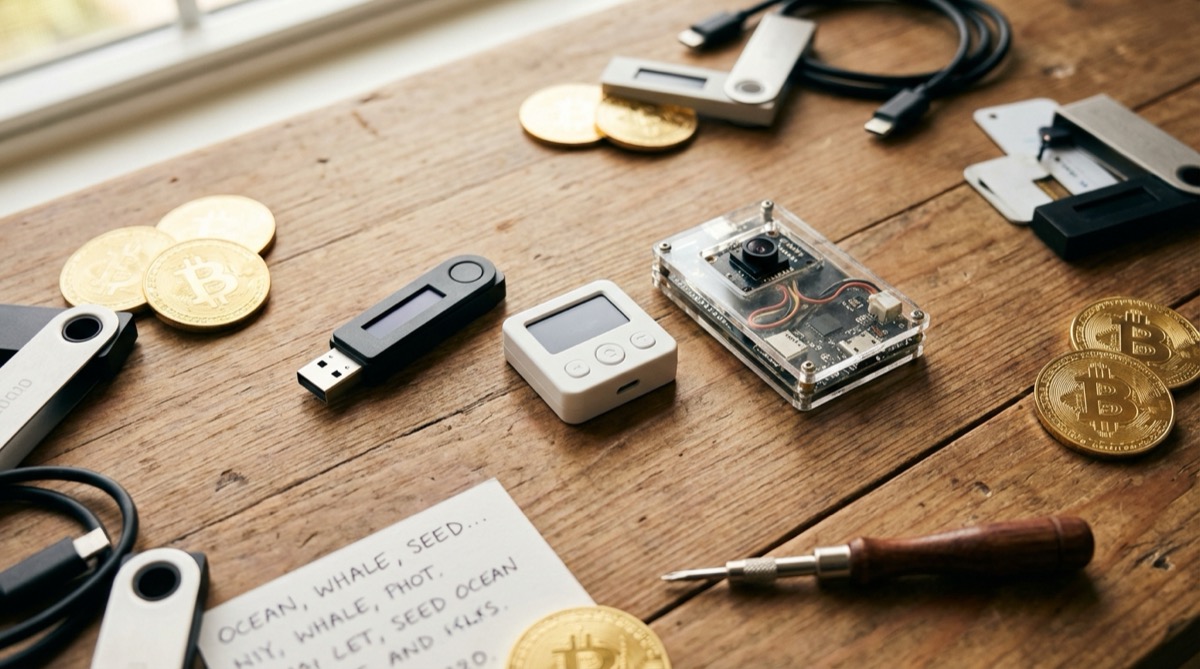
SeedSigner is an open-source project that turns a Raspberry Pi Zero, a camera module, and a small LCD screen into an air-gapped Bitcoin signing device. You assemble it yourself from commodity hardware.
What You Get
- Fully open-source software and hardware
- Air-gapped via QR codes — never connects to any computer
- Stateless design — the device holds no keys in memory after power-off
- Total supply chain control — you source every component yourself
- Multiple enclosure options from 3D-printed cases to retail kits
The Tradeoff
No secure element. The Raspberry Pi Zero is a general-purpose computer, not a tamper-resistant signing device. The SeedSigner compensates with its stateless design — you enter your seed phrase each time you sign, and the device retains nothing after power-off. Assembly requires basic technical comfort. This is not a plug-and-play experience.
Best For
Technically minded users who want maximum transparency and supply chain control. Excellent as a signing device in a multisig quorum where other devices provide the hardware security, and the SeedSigner adds diversity.
What to Avoid in Budget Hardware Wallets
Not every cheap device is a good deal. Here’s what to watch out for:
- Unknown brands with no security track record. A $30 “hardware wallet” from an unknown manufacturer on Amazon is not a bargain — it’s a risk. Stick to established companies with public security audits.
- Devices without a screen. If you can’t verify the transaction address on the device itself, you’re trusting your computer — which defeats the purpose of a hardware wallet.
- Used or secondhand devices. Never buy a hardware wallet from eBay, Craigslist, or any non-official source. Supply chain attacks are a real threat. Always buy directly from the manufacturer.
- Devices that arrive pre-initialized. A legitimate hardware wallet always generates a fresh seed during your setup. If it arrives with a seed phrase printed on paper or already configured, do not use it.
Verdict: Best Budget Pick for 2026
For Bitcoin-only users, the Trezor Safe 3 at $79 offers the best combination of hardware security and transparency. An EAL6+ secure element paired with open-source firmware is a combination you won’t find cheaper anywhere. If air-gapped signing matters, the Blockstream Jade at $65 is the value leader with QR-code support that many premium devices lack. And if you hold multiple cryptocurrencies, the Ledger Nano S Plus at $79 gives you access to the broadest ecosystem at the entry-level price.
For a complete comparison of all hardware wallets, including premium options, check our buying guide and comparison chart.
Frequently Asked Questions
Are cheap hardware wallets safe?
Yes — if they’re from reputable manufacturers. The Trezor Safe 3, Blockstream Jade, and Ledger Nano S Plus all use genuine security architectures and have been independently tested. The security difference between a $79 and $249 device is primarily about usability (screen size, touchscreen, air gap options), not about the fundamental protection of your keys. A $79 Trezor Safe 3 has the same EAL6+ secure element as the $169 Safe 5.
What’s the absolute cheapest secure way to store Bitcoin offline?
A SeedSigner built from a Raspberry Pi Zero, camera module, and LCD screen costs about $50 in parts. It’s air-gapped, open-source, and stateless. The tradeoff is that you assemble it yourself and it lacks a secure element. For a plug-and-play device, the Blockstream Jade at $65 is the cheapest ready-made option with air-gap support.
Should I buy a used hardware wallet to save money?
No. The $15-30 you might save is not worth the supply chain risk. A used device may have been tampered with, pre-loaded with compromised firmware, or set up with a known seed phrase. Always buy directly from the manufacturer’s official store. See our cold vs hot wallet security guide for more on why this matters.
Is a $65 wallet secure enough for $10,000+ in Bitcoin?
The dollar amount of your holdings doesn’t change the security properties of the device. A Blockstream Jade protects $10,000 the same way it protects $100 — with air-gapped signing and encrypted key storage. That said, for larger amounts, consider a multisig setup with devices from multiple manufacturers. The total cost of three budget devices (~$200) provides stronger security than any single premium device.